



Gang-Related Offenses
Gang-Related Crime
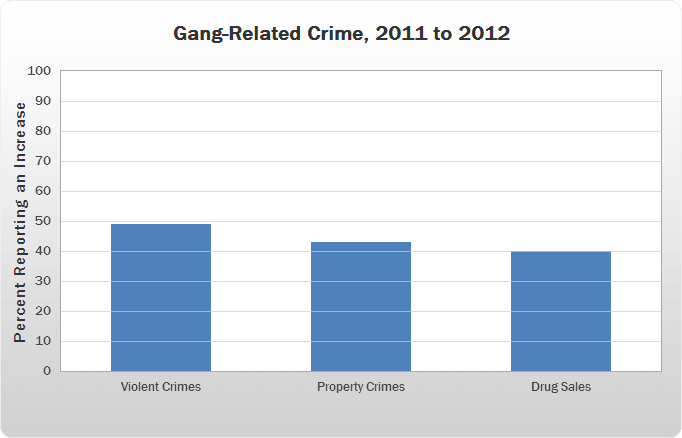
Respondents provided information regarding gang-related crimes in their jurisdictions. The figure presents the percentage of agencies reporting an increase from 2011 to 2012.
- Among agencies reporting a gang problem, approximately half also reported an increase in nonlethal gang-related violent crime (49 percent), and 43 percent reported an increase in gang-related property crime from 2011 to 2012.
- About 40 percent of the agencies reported an increase in gang-related drug offenses.
| Percent Reporting an Increase | |
|---|---|
| Violent Crimes | 48.9% |
| Property Crimes | 42.9% |
| Drug Sales | 39.9% |
Analysis for this section pertains only to law enforcement agencies reporting gang problems. Please see the Prevalence of Gang Problems section.
Factors Influencing Gang-Related Violence
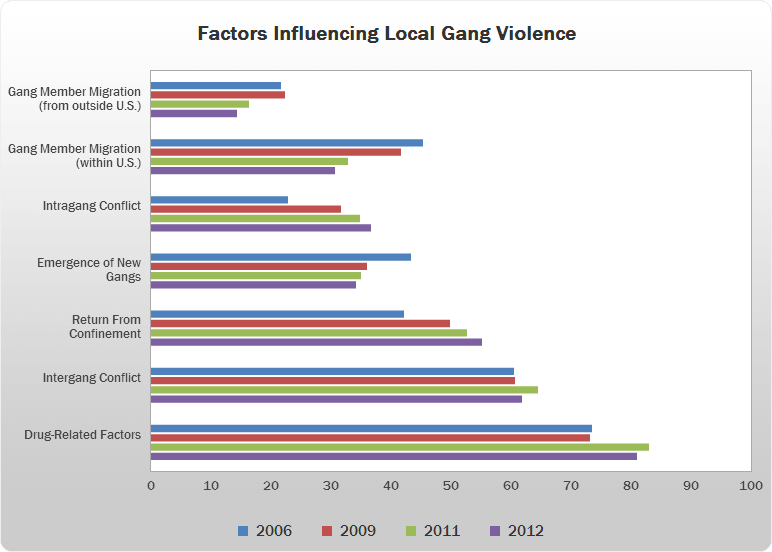
Respondents indicated the factor(s) that significantly influenced gang-related violence in their jurisdictions.
- In each year, a clear majority of agencies reported that intergang (between-gang) conflict and drug-related factors directly affected local levels of gang violence.
- Somewhat frequently reported (more than one-third of the agencies) in 2012 were the following three factors: the return of gang members from secure confinement, intragang (within-gang) conflict, and the emergence of new gangs.
- Two factors, gang members returning from confinement and intragang conflict, increased in importance by more than 10 percentage points from 2006 to 2012.
- In contrast, gang-member migration and the emergence of new gangs noticeably declined in importance over survey years.
| 2006 | 2009 | 2011 | 2012 | |
|---|---|---|---|---|
| Gang Member Migration (from outside U.S.) | 21.7 | 22.3 | 16.4 | 14.3 |
| Gang Member Migration (within U.S.) | 45.4 | 41.7 | 32.9 | 30.7 |
| Intragang Conflict | 22.9 | 31.7 | 34.8 | 36.7 |
| Emergence of New Gangs | 43.3 | 36.0 | 35.0 | 34.2 |
| Return From Confinement | 42.1 | 49.9 | 52.6 | 55.2 |
| Intergang Conflict | 60.5 | 60.7 | 64.5 | 61.8 |
| Drug-Related Factors | 73.5 | 73.2 | 83.0 | 81.0 |
Analysis for this section pertains only to law enforcement agencies reporting gang problems. Please see the Prevalence of Gang Problems section.
Regularly Record Any Criminal Offense as “Gang-Related”
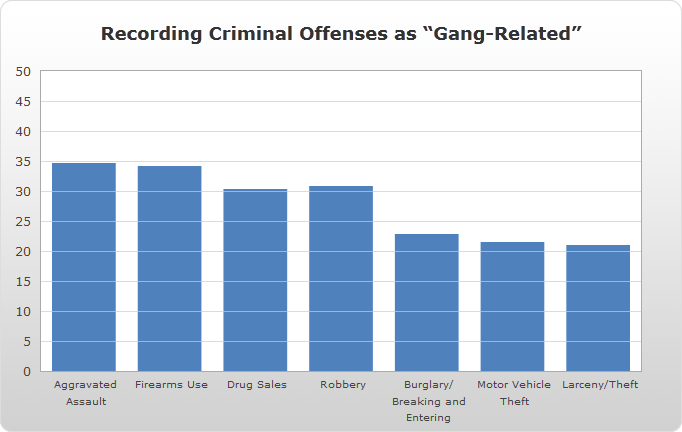
Respondents indicated whether their agencies have instituted procedures for regularly recording criminal offenses as “gang-related.”
- Other than homicides and graffiti, law enforcement agencies generally do not record any criminal offenses as “gang-related.”
- Across the seven offenses below, one-third or less of the agencies reported that they regularly record each as “gang-related.”
- Respondents reported recording person offenses, firearms use, and drug crimes as “gang-related” at a slightly higher rate compared with property-related crimes.
- The relative lack of definitive and comprehensive gang-crime statistics for violent and nonviolent offenses alike signifies that much remains unknown about gang crime trends.
| Agencies With Reporting Procedure | |
|---|---|
| Aggravated Assault | 34.6% |
| Firearms Use | 34.1% |
| Drug Sales | 30.4% |
| Robbery | 30.8% |
| Burglary/Breaking and Entering | 22.8% |
| Motor Vehicle Theft | 21.5% |
| Larceny/Theft | 21.0% |
Analysis for this section pertains only to law enforcement agencies reporting gang problems. Please see the Prevalence of Gang Problems section.
« PreviousTable of Contents Next »
Suggested citation: National Gang Center. National Youth Gang Survey Analysis. Retrieved [date] from https://nationalgangcenter.ojp.gov/survey-analysis.