



Prevalence of Gang Problems
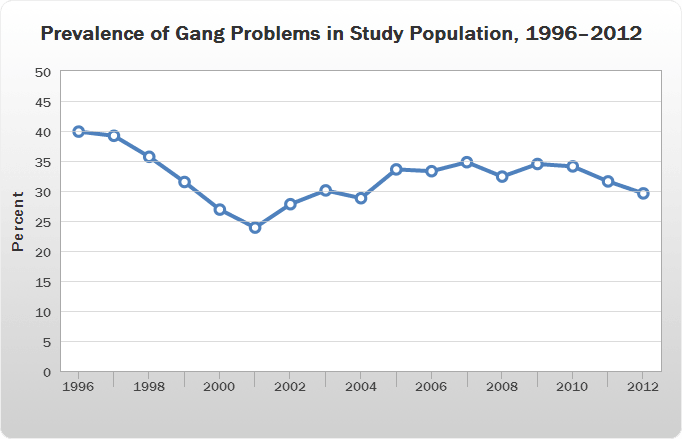
Prevalence of Gang Problems in Study Population
Respondents provided information regarding the presence or absence of active gangs in their jurisdictions.
- Following a marked decline from the mid-1990s to the early 2000s, the prevalence rate of gang activity significantly increased between 2001 and 2005 and has since remained fairly constant.
- From 2005 to 2012, approximately one-third of the agencies in the study population experienced gang problems.
- Overall, an estimated 3,100 jurisdictions in the study population experienced gang problems in 2012.
- The 2012 estimate represents a statistically significant increase over the lowest point recorded in 2001, but no statistically significant change from the previous year.
| Year | Percent |
|---|---|
| 1996 | 39.9 |
| 1997 | 39.2 |
| 1998 | 35.7 |
| 1999 | 31.5 |
| 2000 | 26.9 |
| 2001 | 23.9 |
| 2002 | 27.8 |
| 2003 | 30.1 |
| 2004 | 28.8 |
| 2005 | 33.6 |
| 2006 | 33.3 |
| 2007 | 34.8 |
| 2008 | 32.4 |
| 2009 | 34.5 |
| 2010 | 34.1 |
| 2011 | 31.6 |
| 2012 | 29.6 |
Description
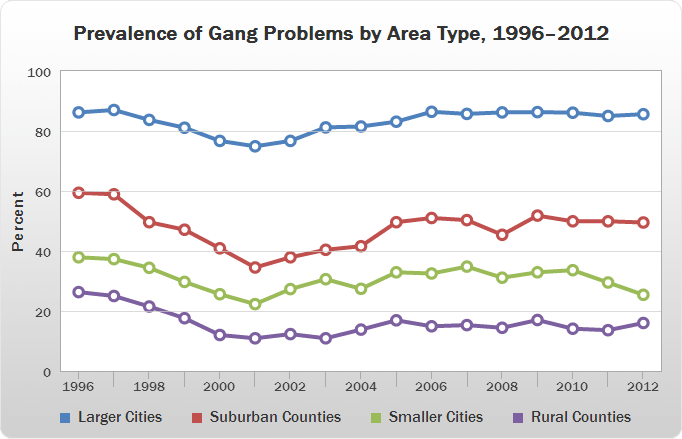
Prevalence of Gang Problems by Area Type
The presence of active gangs is displayed by area type.
- During the 16-year study period, the trends in prevalence rates of gang problems are remarkably similar across area types, albeit at different levels.
- Within each area type, the percentage of agencies reporting gang problems in 2012 is as follows: 86 percent larger cities, 50 percent suburban counties, 25 percent smaller cities, and 16 percent rural counties.
- Gang problems are most widespread in the largest cities in the United States; specifically, nearly all law enforcement agencies serving cities with populations of 100,000 or more have reported multiple years of gang problems.
| Year | Cities With Populations of 50,000 or More (Larger Cities) |
Suburban Counties | Cities With Populations Between 2,500 and 49,999 (Smaller Cities) |
Rural Counties |
|---|---|---|---|---|
| 1996 | 86.2 | 59.4 | 37.9 | 26.3 |
| 1997 | 87.0 | 58.9 | 37.3 | 25.0 |
| 1998 | 83.7 | 49.6 | 34.4 | 21.5 |
| 1999 | 81.1 | 47.1 | 29.7 | 17.6 |
| 2000 | 76.7 | 40.9 | 25.6 | 12.0 |
| 2001 | 74.9 | 34.5 | 22.3 | 10.9 |
| 2002 | 76.7 | 37.9 | 27.3 | 12.3 |
| 2003 | 81.2 | 40.4 | 30.6 | 10.9 |
| 2004 | 81.5 | 41.6 | 27.4 | 13.8 |
| 2005 | 83.1 | 49.6 | 32.9 | 16.9 |
| 2006 | 86.4 | 51.0 | 32.5 | 14.9 |
| 2007 | 85.7 | 50.3 | 34.8 | 15.3 |
| 2008 | 86.2 | 45.4 | 31.1 | 14.4 |
| 2009 | 86.3 | 51.8 | 32.9 | 17.0 |
| 2010 | 86.1 | 49.9 | 33.6 | 14.1 |
| 2011 | 85.0 | 49.9 | 29.5 | 13.6 |
| 2012 | 85.6 | 49.5 | 25.4 | 16.0 |
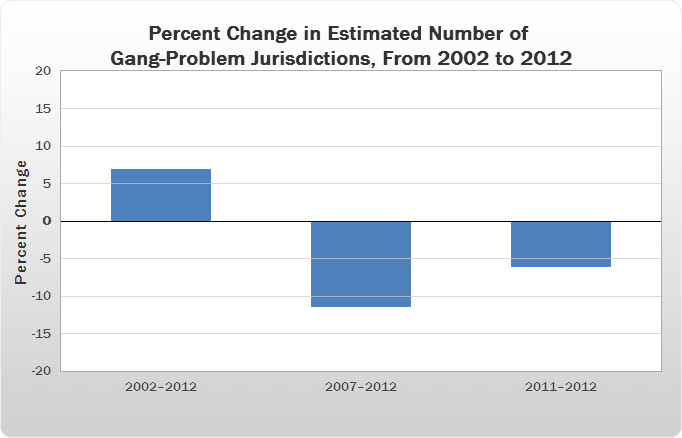
Percent Change in Estimated Number of Gang-Problem Jurisdictions
The percent change in estimated number of gang-problem jurisdictions between 2002 and 2012 is presented.
- Overall, the estimated number of gang-problem jurisdictions in the study population in 2012 is 7 percent higher than in 2002 but 11 percent lower than in 2007 and 6 percent lower than in 2011.
- As noted above, the increase in prevalence rates from 2002 to 2012 occurred in all area types, except smaller cities.
| 2002–2012 | 2007–2012 | 2011–2012 | |
|---|---|---|---|
| Percent Change | 6.9 | -11.4 | -6.1 |
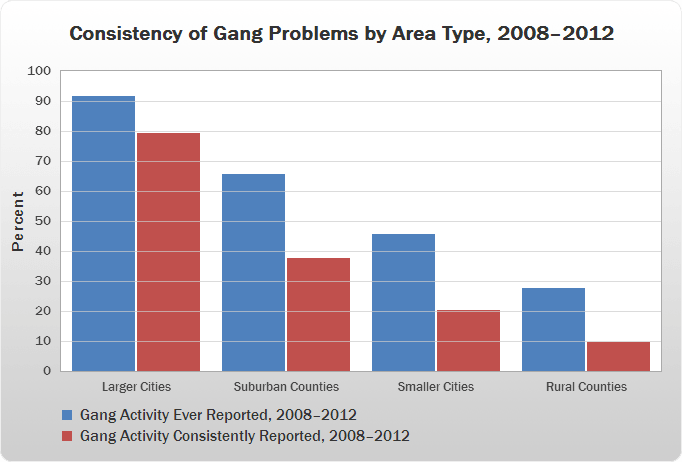
Consistency of Gang Problems by Area Type
The percentage of agencies that have ever reported gang activity and the percentage that have consistently reported gang activity from 2008 to 2012 are displayed by area type.
- A larger discrepancy between the two figures within each area type indicates greater instability and a fluctuating pattern of gang problems across jurisdictions over time. Conversely, greater similarity between these figures indicates that roughly the same group of agencies is reporting gang problems across survey years.
- Gang problems are more consistently reported in larger cities: 92 percent reported ever having a gang problem, and 79 percent consistently did so from 2008 to 2012.
- While 66 percent of suburban counties reported ever having a gang problem, 38 percent did so consistently over the five-year time period.
- Comparatively, less-sizeable but noticeable differences are observed within smaller cities and rural counties.
- Overall, these results demonstrate that the presence of gang problems outside larger cities is less stably observed and reported over time.
| Gang Activity Ever Reported, 2008–2012 | Gang Activity Consistently Reported, 2008–2012 | |
|---|---|---|
| Larger Cities | 91.6 | 79.4 |
| Suburban Counties | 65.8 | 37.8 |
| Smaller Cities | 45.7 | 20.3 |
| Rural Counties | 27.8 | 9.8 |
« PreviousTable of Contents Next »
Suggested citation: National Gang Center. National Youth Gang Survey Analysis.
Retrieved [date] from https://nationalgangcenter.ojp.gov/survey-analysis.